
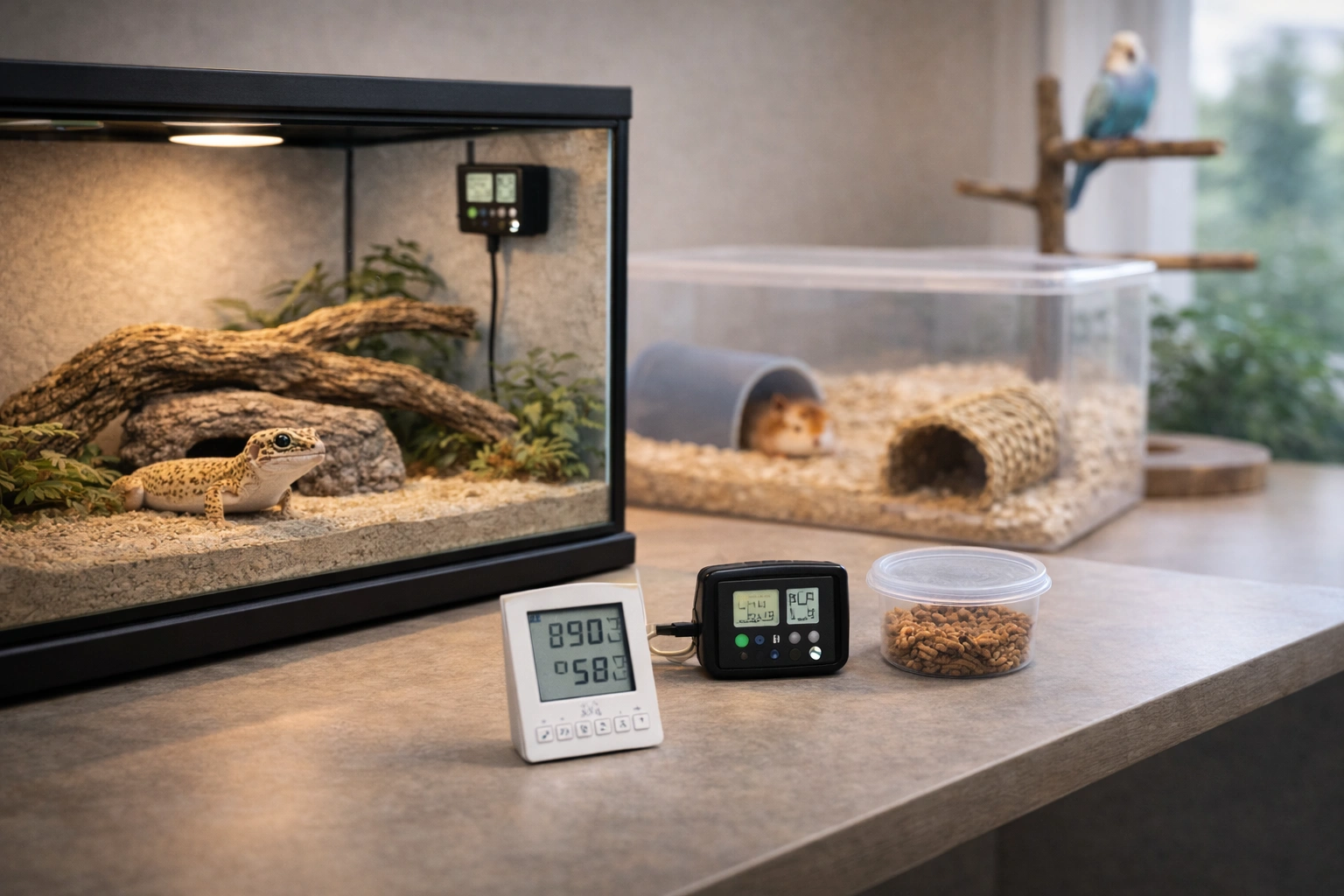
Setup first (the rule that prevents most problems)
For exotics, the environment is the care plan. Many issues that look like “health problems” are actually husbandry problems: too cold, too dry, too wet, incorrect lighting, unsafe substrate, or chronic stress.
The best practice is simple: build and stabilize the setup before you bring the pet home. That means running heat/lighting on timers, confirming gradients, and verifying humidity for several days.
Enclosure basics (space, security, ventilation)
A “good” enclosure isn’t the most expensive one. It’s the one that is safe, secure, appropriately sized, and easy to maintain. Under-sized habitats increase stress, reduce movement, and make temperature/humidity harder to control.

Enclosure fundamentals (any exotic)
- Security: locking lids/doors; no gaps; no loose screens that can be pushed open.
- Ventilation: stable airflow reduces mold and respiratory risk; avoid stagnant, sealed boxes.
- Easy cleaning: you should be able to spot-clean quickly without dismantling everything.
- Safe layout: hides, perches, and shelters should feel “predictable,” not chaotic.
Heat, UV, and lighting (measure it, don’t guess)
Heat and light are where many exotic setups fail—not because people don’t care, but because it’s easy to underestimate how specific these needs are. For many reptiles, proper heat and (species-dependent) UVB support normal behavior, appetite, and long-term health.

What “good” looks like
- A temperature gradient: a warm area and a cooler area, so the animal can self-regulate.
- Controlled heat: a thermostat controller when applicable; probes placed correctly.
- Consistent photoperiod: timers for day/night rhythm rather than random light patterns.
- Species-appropriate UV/lighting: varies by species—verify distance and placement, and replace bulbs on schedule.
Humidity and hydration (stability beats spikes)
Humidity issues usually come from two extremes: habitats that dry out constantly, or habitats that stay damp and poorly ventilated. The goal is not constant misting—it’s stable, species-appropriate humidity with clean hydration access.

Humidity/hydration essentials
- Measure: use a hygrometer; don’t guess humidity by “how it looks.”
- Provide clean water access: bowls, drip systems, or species-appropriate hydration methods.
- Use the right substrate strategy: some species need dry bedding; others need humidity zones or humid hides.
- Prevent mold: airflow + spot cleaning + avoiding constantly wet substrate.
Diet and feeding (species-appropriate basics)
Diet is more than “what they’ll eat.” It’s nutrients, variety, and consistency over time. Many exotics do best when feeding is measured, scheduled, and species-aligned, not improvised.

Diet principles that apply broadly
- Know the staple: what should be the main diet vs. occasional treats.
- Measure portions: avoid chronic overfeeding; track appetite changes (a useful early warning sign).
- Water and minerals matter: hydration and balanced nutrition are often the difference-maker.
- Don’t guess supplements: use species-appropriate guidance and avoid excessive dosing.
Cleaning, quarantine, and “new pet” safety
Exotic setups stay healthy when cleaning is routine and predictable. The goal is to reduce waste buildup, prevent mold, and minimize stress. For multi-pet homes, quarantine reduces the chance of spreading parasites or illness.
Enrichment and handling (stress reduction)
Stress is a silent driver of exotic health problems. Enrichment is not “extra”—it is part of building a predictable environment where the animal can hide, explore, and feel secure.

Enrichment staples by category
- Reptiles: multiple hides, climbing options (if appropriate), stable basking/retreat zones.
- Small mammals: hides, tunnels, chew-safe items, predictable feeding locations.
- Birds: varied perch thickness, foraging toys, safe chew/shred options, out-of-cage time (species-dependent).
Quick-start checklists (reptiles, small mammals, birds)
Use these as baseline checklists. Your exact species will refine the details, but these cover the “must-haves” that prevent the most common setup failures.
Reptiles (baseline checklist)
Small mammals (baseline checklist)
Birds (baseline checklist)
Common mistakes (and how to avoid them)
Most “beginner problems” are predictable. Fixing them is usually about switching from guessing to measuring, and from random changes to stable routines.

High-impact mistakes to avoid
- Buying the pet before the setup is stable: run and verify the habitat first.
- No temperature/humidity tools: measurement is non-negotiable for many exotics.
- Uncontrolled heating: stability and control matter more than raw heat.
- Undersized habitat: stress rises and stability becomes harder.
- Random feeding: establish a measured, species-appropriate routine.
- Over-handling early: acclimation first, handling later.
Shopping checklist (what to buy first)
If you’re building a setup from scratch, buy the “stability items” first—tools that make the environment consistent—then décor.
FAQ
Do all reptiles need UVB?
Many reptiles benefit from UVB, but requirements vary by species and lifestyle. Use species-specific guidance and verify correct placement and replacement schedule for your lighting setup.
What’s the biggest “beginner mistake” with exotics?
Bringing the animal home before the habitat is stable. Running the enclosure for several days and confirming temperatures/humidity is one of the best risk-reduction steps you can take.
How do I know if my enclosure is “big enough”?
A good enclosure allows normal movement and behavior and makes it possible to create stable zones (warm/cool, dry/humid, retreat areas). If you can’t build stable zones or the animal can’t move naturally, it’s usually too small.
Do birds and small mammals need enrichment?
Yes—enrichment reduces stress, supports normal behavior, and can prevent problems driven by boredom. Start simple and prioritize safe, species-appropriate options.
Should I quarantine a new exotic pet?
If you already own other exotics, quarantine is a strong safety practice. Separate habitat and tools can reduce cross-contamination risk while the new pet acclimates and you monitor appetite and behavior.
Quick summary
- Set up and stabilize the habitat before you bring your pet home.
- Measure heat and humidity—don’t guess.
- Use species-appropriate lighting/UV and consistent timers.
- Build diet routines around staple foods and measured portions.
- Reduce stress with hides, perches, and enrichment.
- Keep a simple cleaning routine and consider quarantine in multi-pet homes.
Related articles
BullyRoom Editorial Team publishes practical guides for safer pet adoption, rehoming, and responsible ownership across all species. Learn more about BullyRoom or contact support.